
Joe Mihalic
A Different Way to Think about Money
I paid off $90,000 of Harvard Business School debt in seven months, spent the next 13 years at Apple, and built enough financial freedom to eventually walk away.
But the most important thing I learned about money came from somewhere else: 20 years working in operations taught me that resources are finite, demand is not, and everything depends on what you choose to prioritize.
Today, I’m bringing that operating discipline to household money through Cashographer.
Available for podcasts, interviews, conferences, organizations, panels, and workshops.
Most people aren’t bad with money. They’re operating without a system.
Household finances face the same basic problem every operation does: demand exceeds supply.
In operations, you don’t pretend resources are unlimited. You measure what you have, analyze demand, establish priorities, allocate scarce resources, and track everything.
Resources are constrained. Something has to come first.
Eventually, I looked at personal finance and started asking a question that still bothers me:
How do we not have a better system for doing exactly the same thing with household money?
We send people into adulthood expected to manage one of the most important resources in their lives without ever really teaching them how. Then we hand them a pile of disconnected rules:
Save for retirement.
Build an emergency fund.
Pay off debt.
Save for college.
Buy a house.
Invest.
Enjoy your life.
Don’t spend too much.
All perfectly reasonable advice. But what happens when you can’t do all of it at once? What comes first? What waits? What does spending another $10,000 here mean for the goal over there?
That’s the part I think personal finance gets wrong. Financial decisions aren’t independent. They’re competing for the same dollars.
When people can’t see those connections, they get overwhelmed. Then we call them “bad with money.”
I don’t buy that.
Most people aren’t irresponsible. They aren’t stupid. And they don’t need another hack, lecture, or rule of thumb.
They need a system to:
See where they stand
Decide what matters most
Allocate the money they actually have
Measure what happened
Make the next decision with their eyes open
That’s what I set out to build with Cashographer. I don’t believe there is one mathematically correct way to live your life. Your priorities are yours. But I do believe there is a better way to run your money.
The process is disciplined. The priorities are personal.
Conversations worth having
I’m not interested in reciting financial rules people have heard a hundred times. These are the questions I can’t stop thinking about and the conversations I’d love to bring to your audience.
Why are we still blaming people for being “bad with money”?
We expect adults to manage hundreds of thousands—sometimes millions—of dollars over their lifetimes, barely teach them how, give them a pile of disconnected financial rules, and then act surprised when they struggle. I think we’ve diagnosed the problem wrong. Most people aren’t bad with money. They’ve never been given a system for running it.
Personal finance is an allocation problem.
Your income is finite. The demands on it aren’t. Retirement, kids, housing, debt, travel, emergencies, generosity, and everything else you want from life are competing for the same dollars. I spent roughly 20 years in operations—including 13 at Apple—dealing with the same basic problem: understand demand, establish priorities, allocate scarce supply, and measure what happened. Why should household money work any differently?
Think about money hard for three hours a month. Then go live your life.
Financial freedom shouldn’t require thinking about money all day. I’d rather spend a few focused hours measuring what happened, comparing it to the plan, and making the decisions that matter—then spend the rest of the month thinking about family, work, and the life money is supposed to support. The point of managing money well is to think about it less, not more.
I paid off $90,000 in seven months. Fifteen years later, here’s what I think about it.
In 2011, eliminating my Harvard Business School debt became an all-consuming experiment. It worked. And I’m still proud of it. But fifteen years later, I’m much less interested in optimizing every dollar than I am in asking a harder question: What are you actually trying to make your money do for your life? Sometimes the mathematically optimal decision is not the right decision for you.
What happens when you finally have enough to walk away?
For years, financial independence was an abstract destination. Then it became real enough for me to leave a 13-year career at Apple. Walking away from a high-paying job destroyed financial value on paper, but it improved my life. I’m healthier, less stressed, more present with my family, and building something I care about. “More money” and “a better life” are not always the same objective.
This isn’t theory.
I put my own money through the wringer.
In 2011, I paid off roughly $90,000 of Harvard Business School debt in seven months and documented the entire experiment publicly on No More Harvard Debt—the wins, the mistakes, the trade-offs, all of it.

I spent two decades learning how allocation actually works.
My career was in operations, including 13 years at Apple. I worked inside a global supply chain where demand, constraints, priorities, and scarce supply weren’t concepts in a textbook. They were the job.
Then I built the system I couldn’t find anywhere else.
Cashographer takes those same operating principles and applies them to household money: understand the baseline, establish priorities, allocate available cash flow, measure what actually happened, and adjust.

Joe in action
I’ve been talking publicly about money for nearly 15 years on television, behind a microphone, and in front of live audiences. Here are a few places to start.
Rich in Money. Poor in Time.
How Financial Freedom Gave Me the Option to Walk Away
Live presentation · Oak Hills Stake Youth Fireside · January 2026
Audience of 60+ youth and adults · Austin, Texas
More conversations
CNN Newsroom · 2012
The original No More Harvard Debt story — and why paying off $90,000 was ultimately about freedom and having options.



The Dave Ramsey Show · 2012
Talking through the seven-month debt-payoff experiment just a few months after it ended.
The story got some attention.


See the system for yourself.
I can talk about allocation, priorities, and operating discipline all day. But you don’t have to take my word for it.
If you’re considering me for a podcast, event, interview, or organization, I’ll give you complimentary access to the Cashographer Map Room—the actual system, tools, and training behind the ideas on this page.
If you only have ten minutes, poke around these four areas:
Start Here
See how the process is organized and how the pieces fit together.
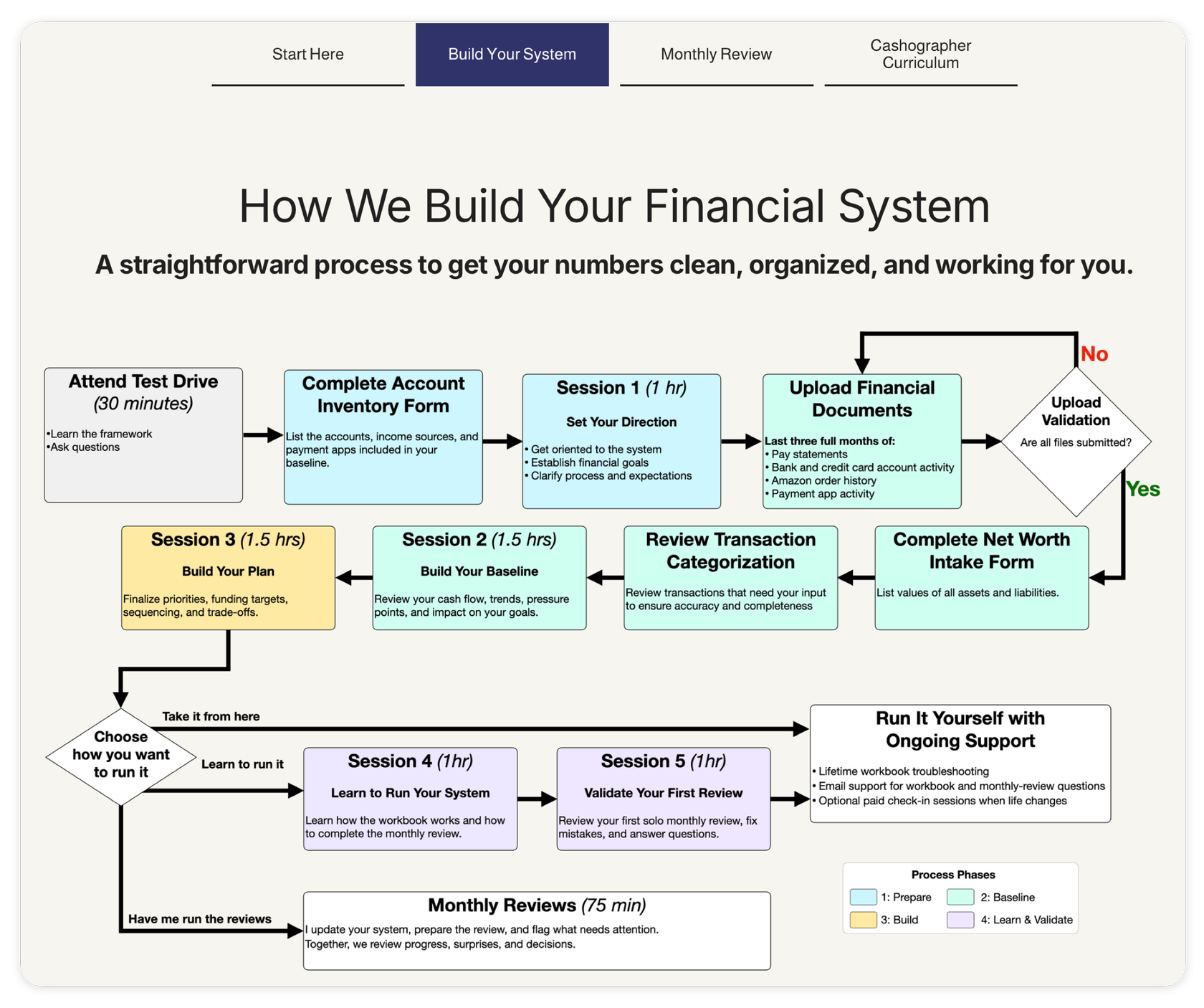
Build Your System
See how scattered financial information becomes one working system—baseline, priorities, cash flow, and plan.
Monthly Review
See how the system stays alive: measure what happened, update the numbers, and decide what comes next.
Cashographer Curriculum
Explore the concepts, walkthroughs, and training behind the methodology.
Use the complimentary access code I sent you when prompted.
Invite Joe
Have a podcast, event, organization, or audience you think I’d be a good fit for? Tell me a little about it.